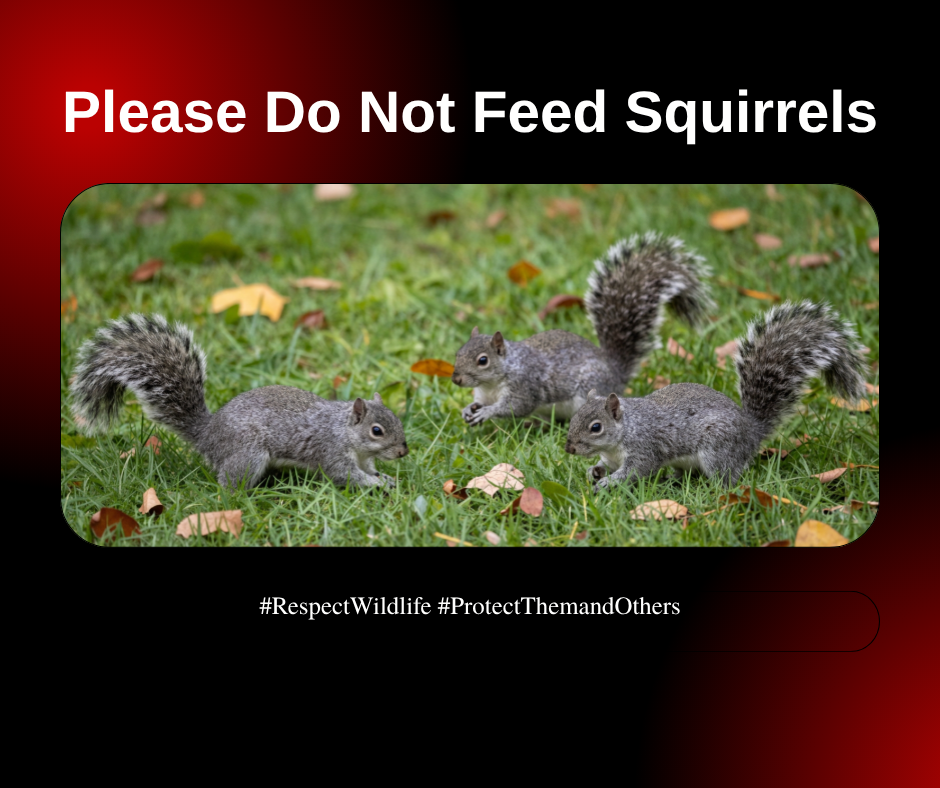
If you’ve ever spent time in a park, you’ve probably had it happen—a squirrel scampers up, pauses, and looks right at you like it’s asking for a snack.
It’s easy to think, “What’s the harm in tossing it a peanut or a cracker or a piece of my sandwich?”
But the truth is, feeding squirrels (and other wildlife) creates a chain reaction of problems—for the animals, the park, and the people enjoying it.
Let’s talk about why.
It Starts With Good Intentions
Most people who feed squirrels are simply trying to help—or they enjoy the interaction. And honestly, squirrels make it hard to resist. They’re cute, curious, clever, and surprisingly bold.
But that boldness?
That’s actually part of the problem.
🐿️ Feeding Leads to Aggressive Behavior
When squirrels are fed regularly, they start to associate people with food.
At first, that looks harmless—maybe even cute. But over time, the behavior changes.
Squirrels lose their natural fear of people.
They begin to approach, follow, and expect food
If they don’t get it, they can become pushy or even aggressive.
That’s when you start to see:
Squirrels grabbing at bags or backpacks
Chasing people around picnic tables
Biting or scratching when food isn’t given
We have had several reports of all these things happening in our park over the last month, resulting in blood, bandaging and even a trip to the hospital.
Even though they’re small, squirrels are still wild animals—and when they feel threatened or frustrated, they react like it.
🍟 Human Food Isn’t Healthy for Wildlife
Another big issue is diet.
Squirrels don’t need help finding food—they’re built for it. When we feed them:
They may fill up on the wrong foods and miss key nutrients.
Processed foods (chips, bread, snacks) can cause health problems and malnutrition.
They may stop foraging naturally and lose important survival skills.
In other words, what feels like a treat can actually harm them long-term.
🔄 It Creates Dependency (and Bigger Problems Later)
Squirrels learn quickly. If people regularly feed them, they start relying on those handouts.
That leads to a cycle:
Less natural foraging
More hanging around people
More competition and fighting between animals
If the food suddenly stops—like after a busy weekend or season—they can struggle to find enough food on their own. This is why our park staff empties trash cans and picks up trash in the park daily. It is also why we ask people renting shelters and using our ball fields to please make sure all trash, but especially food trash is in trash cans at the end of their events.
What started as a kind gesture can leave them worse off.
🦠 Health and Safety Risks for Everyone
Feeding wildlife doesn’t just impact animals—it affects people too.
When animals gather around food sources:
Disease spreads more easily between animals
There’s a higher risk of germs spreading to humans.
Close contact increases the chance of bites, scratches, and injuries
Even healthy-looking squirrels can carry diseases, which is one more reason to keep your distance.
🌳 It Changes the Park Environment
When feeding becomes common, it changes the whole feel of the park:
Wildlife starts to cluster in busy areas
Natural behaviors and ecosystems are disrupted
Animals may become nuisances instead of something to enjoy
In some cases, animals that become too aggressive have to be removed to protect the public.
That’s the last thing anyone wants. Our beautiful city park is these animals’ homes and there are just too many for us to trap and remove them.
✅ The Simple Rule: Enjoy Wildlife—Don’t Feed It
The good news is, you can still enjoy squirrels and other wildlife safely.
Here’s what helps:
Watch them from a distance
Keep food packed up and trash secured
Clean up crumbs and leftovers after eating
Remind kids (and adults!) not to feed animals
As wildlife experts often say:
“A fed animal is not a safe animal.”
🧡 Final Thought
The best way to care for wildlife isn’t by feeding it—it’s by letting it stay wild.
When we resist the urge to give handouts, we’re actually protecting:
The animal’s health
The natural balance of the park
The safety of everyone around
So next time a squirrel comes a little too close, just smile, enjoy the moment—and keep your snacks to yourself. Or maybe do like my niece Addie does and yell “SQUIRREL!!” to warn them you are coming and move out of your way!